Our Science
Stem Cell Regulation Technology

Stem Cell Regulation Technology
Our skin contains tissue stem cells that give rise to the skin and hair and play an essential role in tissue repair and regeneration. However, these stem cells are highly susceptible to various stresses, including lifestyle-related factors. When their function is impaired, they can lose their natural regenerative capacity, become a source of inflammation, and contribute to chronic conditions such as intractable alopecia and skin ulcers. Evidence also suggests that such stem-cell dysfunction may have systemic effects beyond the skin.
Unlike regenerative medicine approaches that rely on the transplantation of cells or tissues from outside the body, our technology is designed to protect and utilize the body’s own stem cell pool. By enabling endogenous stem cells to expand appropriately and function properly, this approach aims to suppress the underlying triggers of aging and inflammation. As a result, it is expected to offer a disease-modifying approach for chronic diseases involving stem cells. This technology is based on award-winning research recognized by the Commendation for Science and Technology by the Minister of Education, Culture, Sports, Science and Technology, and is supported by scientific findings reported in Matsumura et al., Science, 2016; Nature Aging, 2021; Liu et al., Nature, 2019; and Morinaga et al., 2021.
Based on these discoveries and insights, EADERM is advancing the development of new pharmaceuticals and quasi-drugs by identifying substances that maintain the tissue stem cell pools, preserve their quality and support proper function. Through our proprietary screening platforms, we have conducted large-scale screening and successfully identified and evaluated promising drug discovery seeds for the treatment of skin diseases such as alopecia and skin ulcers. Our pipeline includes multiple development programs, and we are accelerating their development to deliver these innovations to patients as quickly as possible.
Our Pipeline
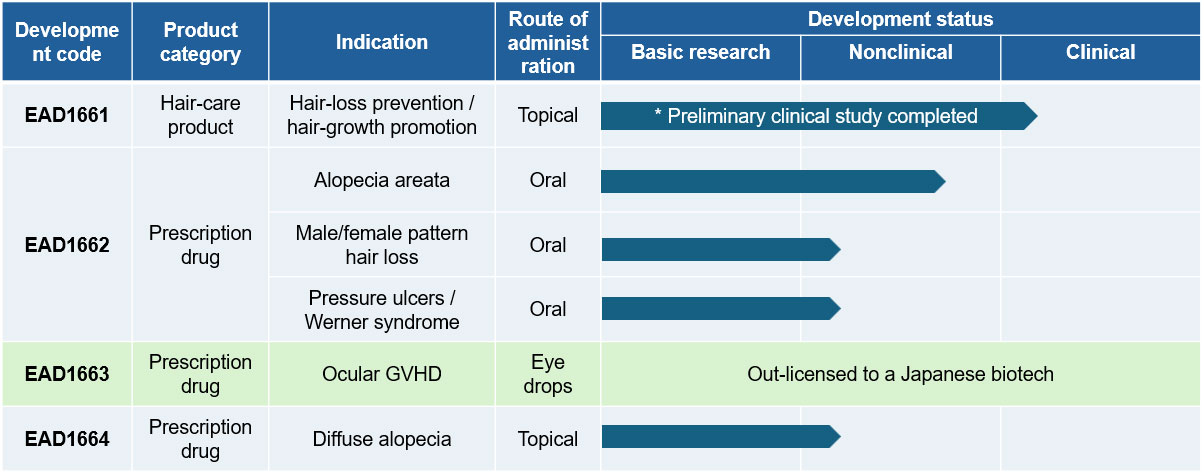
EAD1662 is our lead program, initially targeting alopecia areata, with planned expansion into multiple additional indications.
In parallel, we are also advancing the development of EAD1661.
Scientific Platform and Key Publications